You clip a curb making a tight turn, or drop into a pothole hidden by rainwater. The car seems fine, so you drive on. But a hard hit can damage the tire, the wheel and the suspension, and some problems show up days later.
Stop and look first
If you can do so safely, pull over and check the tire and wheel. Tire-service guidance suggests looking for bulges or bubbles in the sidewall, cuts, cracks, visible cords, and a slow leak or pressure warning. On the wheel, look for bends, dents and any spot where air may escape between the tire and rim.
Tire checklist
- Sidewall bulge or bubble. This means internal damage, and the tire should not be driven on. See our bulge post.
- Cuts, scrapes or exposed cords. Deep damage needs a professional opinion.
- Pressure loss. Check with a gauge and re-check over the next few days.
Wheel checklist
- Bent or cracked rim edge
- Dents or flat spots
- Air loss at the bead (soapy water shows bubbles)
- Vibration in the steering wheel or seat, especially at highway speed
Light cosmetic scuffs on alloy wheels are common. A bend, crack or leak is different and needs inspection. Whether a wheel can be repaired depends on the damage, so ask a professional.
Steering and suspension signs
- The steering wheel sits off-center, or shakes
- The car pulls to one side on a straight road
- Clunks over bumps, or a bouncy, unstable ride
- New humming or grinding
- Uneven tire wear showing up later
These can point to alignment problems or damaged suspension parts such as ball joints, control arms or shocks and struts. A drifting car often signals alignment trouble, and an alignment check is a sensible follow-up after a hard hit.
Quick checklist
- Pull over safely and inspect the tire and wheel.
- Check pressure with a gauge.
- Drive slowly and notice vibration, pulling or noises.
- Re-check pressure and the tires over the next few days.
- Book an inspection if anything feels or looks wrong.
Prevention
- Keep tires at the placard pressure. Underinflated tires are easier to damage.
- Leave extra room in tight turns, and avoid scraping curbs when parking.
- Slow down and scan ahead in heavy rain. Standing water hides potholes around Broward and Miami-Dade.
- Do not brake hard into a pothole. Slow down before the hit, if you can do so safely.
Damage can appear days later, so do not assume you got away with it just because the car feels normal.
When it is time to stop driving
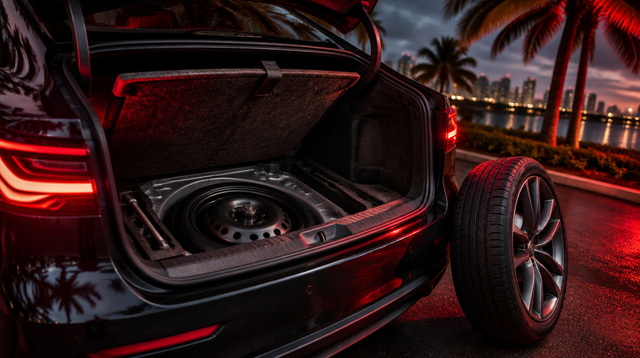
Some signs mean you should not keep driving normally. A sidewall bulge, a tire losing air quickly, a wheel that is visibly bent, a loud grinding noise, or steering that suddenly feels loose or heavy are all reasons to pull over, put on the spare or call for help. When in doubt, a professional opinion is cheaper than a failure at highway speed.
What a shop checks after a hit
A good inspection usually covers the tire inside and out, the wheel for bends or cracks, the alignment angles, and the suspension and steering parts. An alignment check on proper equipment will show whether anything has moved out of specification. If the wheel is bent, a technician can tell you whether it can be repaired or whether it should be replaced.
Why damage can show up later
A tire can have internal damage that does not form a bulge until days after the hit, and a slightly bent wheel may leak air slowly, so you only notice once the pressure warning appears. Alignment problems often show up as uneven tire wear weeks later, after the edge of a tire is already damaged. This is why a quick inspection soon after a hard impact is worth the time.
Protect your wheels
Larger wheels with low-profile tires have less sidewall cushion, so they are more vulnerable to potholes and curbs. If you drive that kind of setup, keep the pressure at the placard value, and take extra care around curbs and in standing water.
Need a hand?
If you hit something hard and are not sure what to check, a quick inspection is a good idea. We can help at our shop in Sunrise, or come to you with mobile tire service across Broward, Miami-Dade and Palm Beach. Call (954) 773-1896 or book online.
Frequently asked questions
Should I get an alignment after hitting a curb?
If the car pulls, the steering wheel is off-center, or tires wear unevenly, yes. After a hard hit, an alignment check is a sensible precaution.
Can a bent wheel be repaired?
Sometimes, depending on the type and severity of the damage. A professional has to inspect it, and cracked wheels are generally not safe to keep using.
How do I know if my tire is damaged after a pothole?
Look for sidewall bulges, cuts and cracks, and check the pressure. Damage can appear later, so re-check over the following days and get it inspected if you are unsure.